
Cleavers
Cleavers (Galium aparine), also known as Sticky Weed, Goose Grass, and Sticky-Willy, is a sprawling, square-stemmed annual that most people consider a nuisance. It can grow up to 4 feet (or more) long and has whorls of lance-shaped leaves every few inches along the stem, with small, white, star-like flowers. The fruit is green and covered in tiny hooks that cling to anything it touches. The whole plant tends to stick to anything it can latch onto once mature, hence the nickname Sticky Weed. It is sometimes called Velcro Weed, though this name is uncommon.
Native to Europe, North Africa, and parts of Asia, cleavers have naturalized in North America and are found in many temperate climates. They are generally among the first spring tonic herbs to sprout. You can find cleavers growing freely in gardens, along roadsides, and virtually anywhere the seeds manage to establish themselves, sometimes as early as December in sheltered areas. This hardy plant can grow almost year-round here in East Texas. I typically find young cleavers around the chicken coop from December to January, though severe winter weather in January or February can occasionally kill them. Still, they usually return by March. In many regions, cleavers sprout before or alongside violets, chickweed, and dandelions in late winter and early spring.
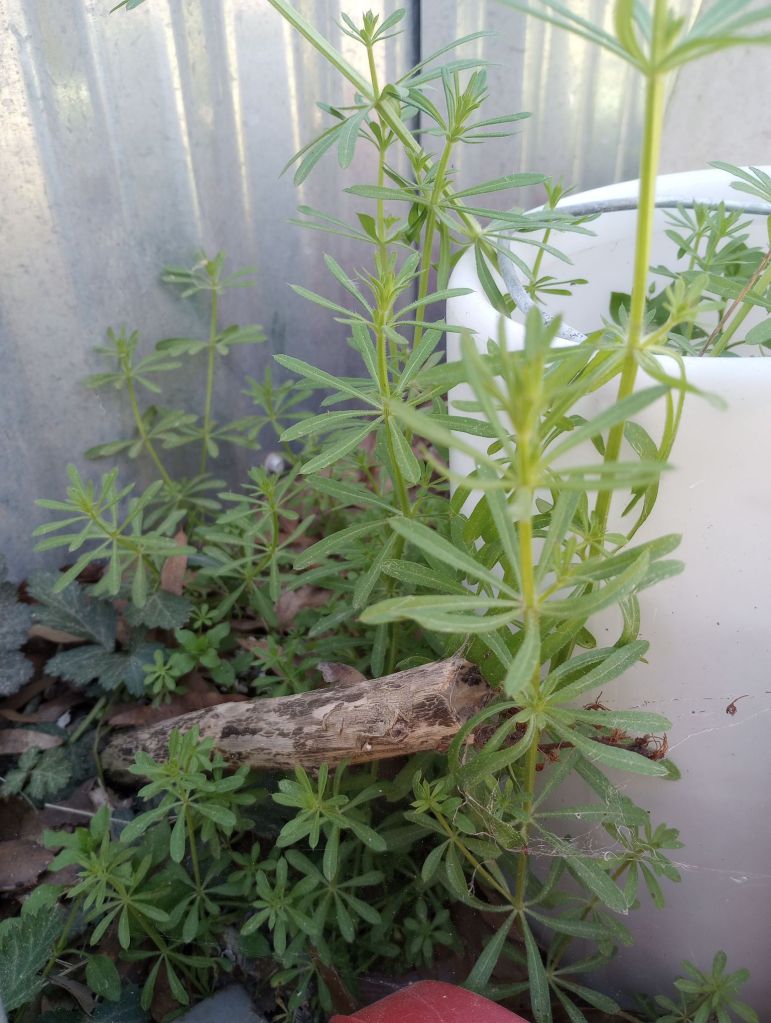
Harvest aerial parts for medicinal use before flowering in mid-to-late spring. The best time to harvest salad greens is February, when the leaves are young and tender.
Cleavers Contain:
- Iridoids (including asperuloside, a mild laxative)
- Polyphenolic acids
- Anthraquinones (found only in the root)
- Alkanes
- Flavonoids
- Tannins
Key Actions & Uses:
- Diuretic (the juice is particularly strong)
- Supports swollen lymph glands
- Detoxifying
- Kidney stones
- Urinary problems
“Dioscorides, a Greek physician of the 1st century AD, considered it useful for countering weariness, and described how shepherds used the stems to make sieves for straining milk.”
— Encyclopedia of Herbal Medicine, 2nd Edition, p. 214
Internally, cleavers can help treat skin issues such as seborrhea, eczema, psoriasis, and swollen lymph glands, while aiding in detoxification. As an early-sprouting plant, cleavers are ideal for a spring cleanse. Juiced like a vegetable (which renders it a potent diuretic), cleavers may help eliminate kidney stones and treat various urinary tract issues. Some studies suggest cleaver extract may also support blood pressure regulation.
Cleavers are most renowned for supporting lymphatic system health. The lymphatic system—composed of organs, vessels, and tissues—maintains fluid balance and protects the body against infection. Cleavers help cleanse and detoxify this system, making them useful for swollen glands, tonsillitis, adenoid issues, and earaches.
Cleavers have also been historically used to help reduce tumors and remove nodular skin growths due to their lymphatic support. They have been consumed as a drink or gargle for cancers of the throat and mouth.
Sun-Infused Cleaver Tea
While cleaver tea can be made with hot water like a regular infusion, a sun-infused method can improve taste:
- Collect, wash, and chop fresh cleavers.
- Place them in a jar and pour cold or room-temperature water over them.
- Let the infusion sit in the sun on a windowsill for a few hours.
- You don’t need to strain; simply pour a cup and drink daily in spring and early summer to support lymphatic health.
You can top the jar with fresh water daily for a few days before replacing it entirely. After the first day, refrigeration prolongs the infusion’s life. Cleavers have a fresh-mown grass smell and may not appeal to everyone’s taste, but their benefits remain.
Cold Infusion Benefits:
- Swollen glands
- Painful breasts
- Fluid retention
- Tonsillitis
- Breast cysts
- Bladder irritation
- Burning urine
Other Medicinal Galium Species:
- Mexican G. orizabense: parasite elimination, fever relief
- New Zealand G. umbrosum: treatment of gonorrhea
- Lady’s Bedstraw (G. verum) and Hedge Bedstraw (G. mollugo): similar medicinal uses to cleavers
Cleavers are best used fresh, as drying reduces potency, similar to chickweed. Juice can be frozen for later use once plants are past their prime.
Cleavers Poultice
Used like a chickweed poultice, a cleaver poultice can treat nettle rash, burns, blisters, and hot skin inflammation:
- Blend a handful of cleavers with 1–2 tablespoons of water per cup of plant material, or mash in a mortar and pestle.
- Fold the mixture into a clean cloth or gauze, or apply it directly to the skin.
- Leave for ~30 minutes and repeat as needed.
“It is a good remedy in the Spring, eaten (being first chopped small, and boiled well) in water-gruel, to cleanse the blood, and strengthen the liver, thereby to keep the body in health, and fitting it for that change of season that is coming.”
— Nicholas Culpepper (1653)
Cleaver Juice / Succus
- Collect and wash fresh cleavers. Chop into manageable pieces and blend into a pulp.
- Place a muslin cloth in a colander over a bowl, pour in the pulp, and press with a weight for ~1 hour.
- Wrap the pulp in muslin and squeeze out the remaining juice.
Preservation Options:
- Alcohol-based: 3 parts juice + 1 part vodka (or 1:1 with Everclear + water). Shelf-stable ~1 year.
- Honey or vegetable glycerin: equal parts juice and sweetener; shorter shelf life, store in the fridge.
Dosage: ¼–½ teaspoon (30–60 drops), 1–2 times per day.
Tip: Combine with dandelion, nettles, and chickweed for a cleansing juice.
Cleaver Juice/Succus Benefits:
- Swollen glands
- Fluid retention
- Tonsillitis
- Breast cysts
- Bladder irritation
- Burning urine
Cleavers Ointment
Mix fresh cleaver juice into anhydrous lanolin until soft and pale green. Apply to dry, cracked, or chapped skin. Store in a cool, dark area.
Garden Weed Tincture
Ingredients:
- Cleavers (pre-seed)
- Dandelion (roots, leaves, flowers)
- Nettle (tops before flowering and roots)
- Curled dock roots
- Burdock roots
- Scrub roots thoroughly.
- Chop all plant material and pack it into a wide-mouth mason jar.
- Cover with 80–100-proof vodka (dilute 190-proof alcohol 1:1 with water).
- Let sit ~1 month, strain, and bottle.
Dosage: 1 teaspoon twice daily for skin problems, weak digestion, anemia, or low energy.
Disclaimer:
The information shared here is for educational purposes only and is not intended as medical advice. Plant identification, preparation, and use should always be approached with care. Common names can refer to multiple species, each with different properties and safety considerations. Please research thoroughly, verify scientific names, and consult qualified professionals before ingesting or using any plant medicinally.